BLOG
POPULAR ARTICLES

/
BLOG
Safe Working Load and Safety Factors in FIBC Bags
24 December, 2025
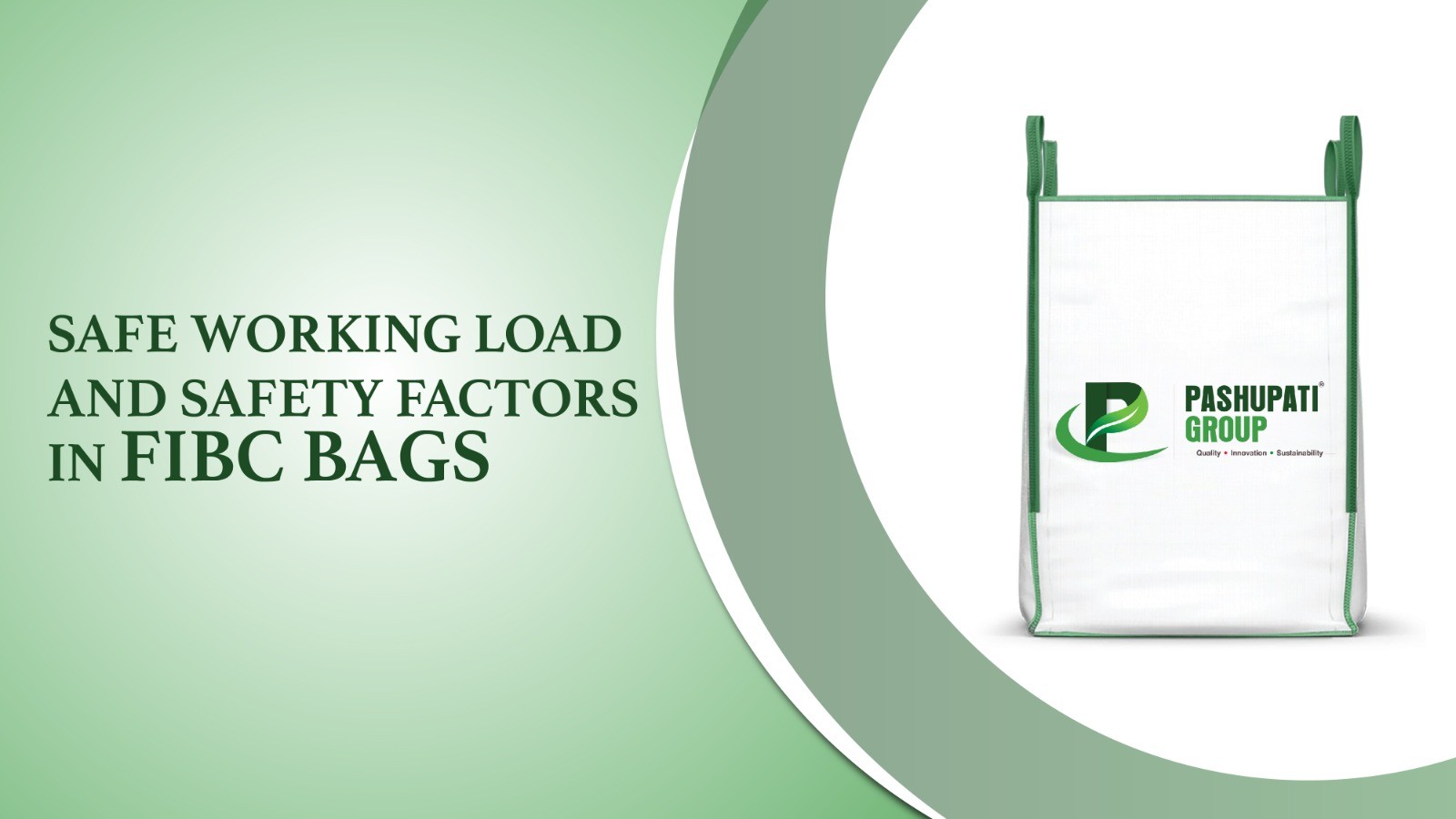
Bulk packaging in agriculture, cement, chemicals and food relies heavily on Flexible Intermediate Bulk Containers, often called FIBC bags or jumbo bags. Each bag can hold 500–2,000 kilograms of product, sometimes more in special designs. A single lift can represent months of work and high cargo value, so every movement has to feel safe and predictable. Two figures on the bag label guide that safety: Safe Working Load and Safety Factor.
In the Indian market, Pashupati Group operates as an integrated FIBC bags manufacturer in India. The group runs polypropylene and HDPE woven fabric lines, lamination, bag conversion and in-house testing for domestic users and international buyers. Design choices around Safe Working Load and Safety Factor sit at the core of this system.
What Safe Working Load Really Means
Safe Working Load, often written as SWL, is the maximum weight that a filled bulk bag is designed to carry through filling, lifting, transport and discharge. The value appears in kilograms on the label, for example 500 kg, 1,000 kg or 2,000 kg. A simple picture is the sign in a lift that says “maximum 8 persons or 544 kg”. The lift can usually handle more, yet the sign gives a clear limit for everyday use.
Most industrial FIBC bags sit in a range of roughly 500–2,000 kg SWL. Lower bands suit lighter powders and granules. Higher bands support dense products such as minerals, metals, fertilisers and cement. Once a plant selects an SWL, filling teams, forklift drivers and warehouse planners set their routines around that figure, so consistent and honest SWL marking becomes very important.
Why Safety Factor Matters
Safe Working Load tells only the visible part of the story. The Safety Factor shows how much strength sits behind that number. It appears as a ratio such as 5:1, 6:1 or 8:1. The first number shows the test load, the second shows the SWL.
A 1,000 kg bag with a 5:1 Safety Factor must survive at least 5,000 kg in a top-lift test. The SWL on the label stays at 1,000 kg, yet the internal design provides a healthy reserve. The Safety Factor acts like a built-in safety margin that protects against real-world shocks, small handling mistakes and variations in product density.
Industry practice groups FIBC bags into three broad classes:
- 5:1 Safety Factor: suits single-trip use with solid products that sit outside dangerous-goods classes.
- 6:1 Safety Factor: supports multi-trip duty and appears widely in regulated and hazardous-goods flows that follow the correct UN design rules.
- 8:1 Safety Factor: carries even higher strength margins for demanding service routes and specialist applications.
Higher Safety Factors demand stronger fabric, additional reinforcement in seams and loops, and more intensive testing. They usually cost more per piece, yet they support reuse programmes and more complex handling cycles. The key is alignment: the Safety Factor should match real handling patterns, product risk and the level of regulatory oversight around the cargo.
How Testing and Standards Support These Numbers
Safe Working Load and Safety Factor rest on structured laboratory testing. Internationally, ISO 21898 sets out how Flexible Intermediate Bulk Containers are designed, tested and marked. In India, BIS standard IS 14738 provides a dedicated framework for FIBC bags that carry solid materials outside dangerous-goods classes. Test houses apply these documents when they certify a design.
Typical programmes include cyclic top-lift tests, where the bag undergoes repeated lifting at multiples of its SWL, and compression or stacking tests that simulate warehouse conditions. Fabric samples, loops and seams also pass through tensile checks. Designs that clear the required margins at the stated Safety Factor proceed to regular production, and only then receive the SWL and Safety Factor figures that appear on the label.
Reading the Label on FIBC Bags
Every quality FIBC label carries more than a product name. It lists:
- the SWL in kilograms
- the Safety Factor ratio
- a design or batch code
- the standard that guided the design, such as ISO 21898, IS 14738 or a UN code
Many bags also show electrostatic type for dusty environments and indicate whether a liner forms part of the performance.
A simple reading habit brings strong benefits. Check the SWL and compare it with the weight of the filled product. Confirm the Safety Factor and match it with the intended duty: single use, controlled reuse or heavy-duty loops. Note the standard and, where relevant, the UN marking. These three checks provide a quick sense of whether an FIBC suits a particular route.
Pashupati Group as an Indian FIBC Partner
Within this framework, Pashupati Group positions bulk bags inside a broader plastics and packaging ecosystem. PP and HDPE tapes run through extrusion and orientation lines, then into circular looms and lamination. From this base, the group develops PP fabrics in the 36.5–250 GSM range and HD fabrics in the 48–117 GSM range, with laminated variants for higher barrier needs. These fabrics form the building blocks of different SWL and Safety Factor combinations.
Designs in the FIBC portfolio cover SWLs from 500 kg up to 2,000 kg at Safety Factors of 5:1 and 6:1, with construction styles that include U-panel, four-panel, circular and baffle bags. For food and pharma products, specialised clean areas add vacuum cleaning, pallet shrink-wrapping, metal detection and light-table inspection, along with statistical inspections that target defect levels as low as 0.01 per cent in certain ranges.
Group capacity figures support large programmes. Published numbers show woven fabric output of roughly 140 tonnes a day, production of several lakh woven sacks a day and daily FIBC output around 10,000 jumbo bags. These volumes, spread across multiple sites in India, allow consistent service as both FIBC bags manufacturer in India and FIBC bags supplier in India for buyers in agriculture, construction, chemicals and food.
Choosing SWL and Safety Factor with Confidence
Three simple steps help buyers and logistics teams select the right jumbo bag. The first step is to map product density and filling patterns, then choose an SWL that stays ahead of the heaviest expected bag weight. The second step is to match Safety Factor with handling intensity and regulatory demands: 5:1 for planned single-trip bags that carry solid cargo outside dangerous-goods classes, 6:1 for structured multi-trip use and many regulated duties, 8:1 for very heavy service where extra reserve brings value.
The third step is to align these figures with a partner that controls the full chain from fabric to finished bag. An integrated jumbo bags manufacturer in India such as Pashupati Group can tune fabric GSM, construction style, liner type and testing plans around the required SWL and Safety Factor. That alignment turns two small numbers on a label into real-world confidence across filling lines, forklifts, warehouses and export yards.
FAQ's
RECENT BLOGS
 (Large).jpg)