BLOG
POPULAR ARTICLES

/
BLOG
Reliable Colour Consistency in Recycled PET Black Masterbatch with PET Bottle Black Masterbatch Control
28 January, 2026
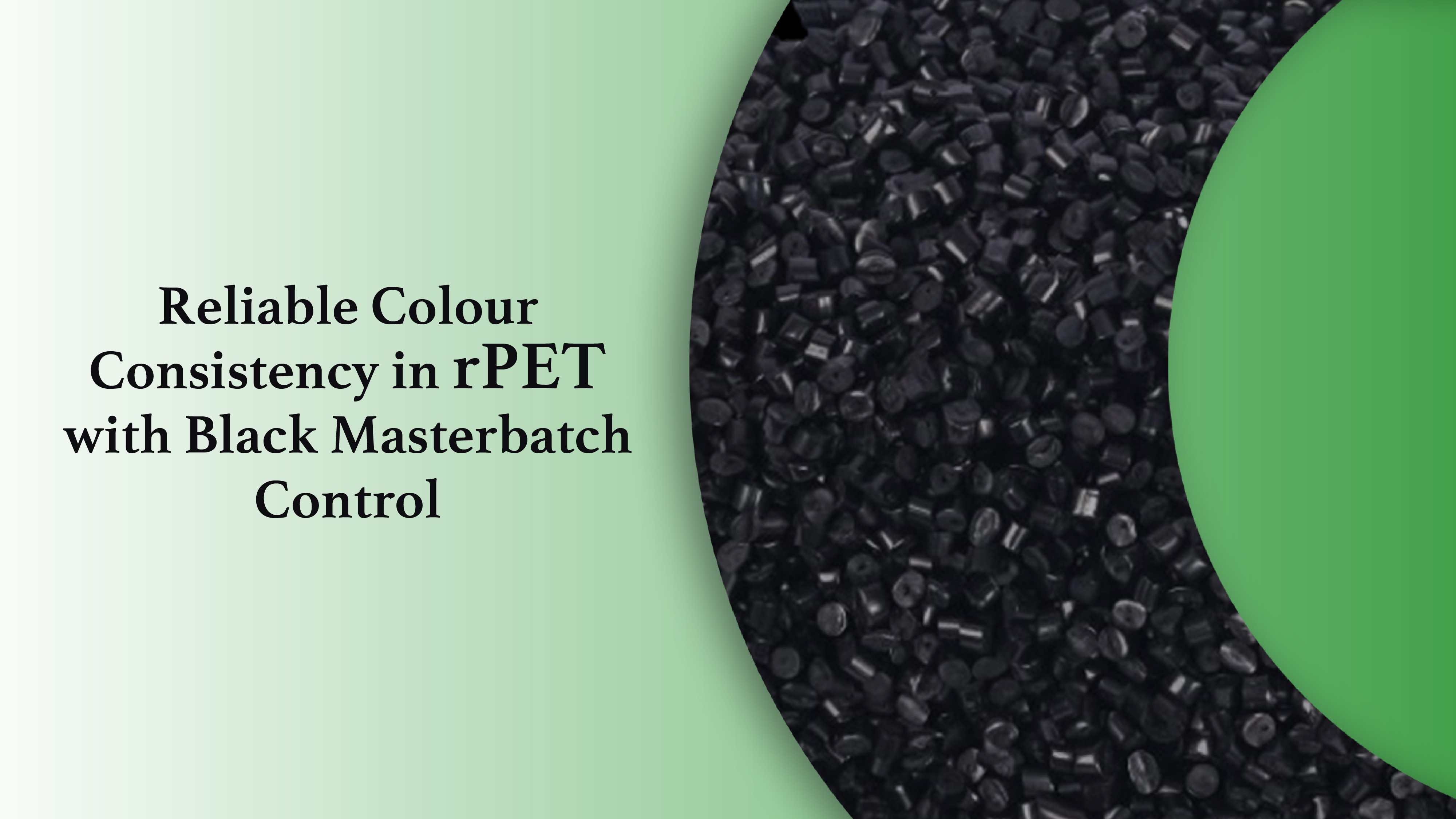
Colour consistency remains one of the biggest operational challenges in recycled PET production. Recycled PET black masterbatch plays an important role because rPET feedstock often comes from different collection systems, different bottle grades, and different previous applications. These variations create visible shifts in base tint, polymer age, and contamination levels, which directly affect final product colour.
Even small shade differences create a major commercial problem. When packaging appears inconsistent on the shelf, it reflects poor quality to buyers. It also increases production downtime because manufacturers must stop lines, adjust settings, and manage unnecessary scrap.
As recycling volumes continue to grow, controlling colour becomes a major competitive advantage. PET recycling rates continue rising across packaging and textile industries, which increases demand for reliable recycled PET black masterbatch solutions. This is where PET bottle black masterbatch becomes essential for maintaining repeatable colour quality at scale.
Why Recycled PET Black Masterbatch Supports Colour Consistency
Black remains one of the most effective solutions for stabilising appearance in recycled PET. A strong recycled PET black masterbatch system helps hide light yellowing, haze, and undertone variation created by multiple heat histories during recycling.
This creates stronger shelf appeal and supports premium presentation across bottles, trays, packaging films, and textile applications. PET bottle black masterbatch also improves contrast for labels, branding, and printed graphics.
A high-quality black masterbatch usually combines carbon black, carrier resin, and performance additives to create controlled pigmentation. However, achieving stable colour still depends on several production factors:
- Carbon black dispersion quality
- Accurate dosing control
- Melt cleanliness
- Stable thermal processing
- Consistent raw material quality
Poor dispersion creates streaks and specks. Inconsistent dosing changes optical density. Excess heat stress pushes unwanted undertones into the final product.
Step 1: Stabilise rPET Input Before Using Recycled PET Black Masterbatch
A recycled PET black masterbatch performs best when the base resin behaves consistently.
Sorting Quality and Contaminant Control
Better sorting improves repeatability. Lower contamination from PVC, caps, labels, adhesives, and inks reduces gels, dark spots, and haze during processing.
Cleaner feedstock improves filtration performance and creates more stable line pressure during production.
Washing and Decontamination Discipline
Strong washing systems reduce residues that trigger yellowing and surface defects. Residual contamination can also interfere with PET bottle black masterbatch dispersion, creating visible shade variation under retail lighting.
Drying Control and Heat History Management
PET is highly sensitive to drying conditions. Stable drying protects intrinsic viscosity and reduces degradation during melting.
Controlled melt temperature and shorter residence time help preserve clarity and minimise unwanted base tint shifts before pigmentation starts.
Step 2: Choose a PET-Optimised PET Bottle Black Masterbatch
Not every black masterbatch is suitable for PET. A PET bottle black masterbatch designed specifically for PET processing performs differently from general-purpose grades.
Carrier Compatibility for Better Blending
Carrier compatibility directly affects how well carbon black disperses into the PET melt. PET-aligned carriers improve blending speed, surface smoothness, and final gloss stability.
This improves both appearance and processing reliability.
Carbon Black Selection and Dispersion
Carbon black grade controls jetness, undertone, opacity, and shade depth.
Higher colour strength allows lower let-down ratios and improves cost efficiency, but only when dispersion quality remains strong. Good recycled PET black masterbatch performance depends heavily on consistent carbon black distribution.
Additive Support Beyond Colour
PET bottle black masterbatch often supports more than just colour.
It also improves:
- UV resistance
- Product durability
- Surface finish
- Opacity control
- Long-term appearance stability
This is especially important for bottles, sheets, containers, fibres, and thermoformed packaging.
Step 3: Lock Dosing and Mixing for Repeated Shade Accuracy
Even high-performance recycled PET black masterbatch cannot maintain consistency if dosing varies during production.
Define Shade Targets and Fixed Let-Down Ratios
Every product should have a fixed target shade and defined let-down ratio based on thickness and application.
Gravimetric dosing provides better consistency than volumetric systems, especially when rPET pellet density changes across lots.
Improve Blend Uniformity Before Processing
Pre-blending rPET with PET bottle black masterbatch improves feed consistency into extrusion, injection moulding, and blow moulding systems.
This reduces short-term colour fluctuations during line startup and speed adjustments.
Keep Processing Stable
Stable screw speed, melt temperature, and line pressure help maintain dispersion quality.
Melt filtration removes contaminants that appear as visible defects in black products. Good hopper cleaning also reduces dust and gloss variation.
Step 4: Measure Colour Consistently
Fast measurement helps prevent production losses caused by gradual colour drift.
Instrument-Based Colour Checks
Spectrophotometer testing provides objective colour measurement using standard plaques, strips, or moulded samples.
Delta E limits should be defined based on customer and brand requirements to detect variation early.
Visual Appearance Checks
Controlled lighting improves inspection of gloss, surface finish, undertones, and speck formation.
A simple light box with fixed sample thickness helps identify changes that normal factory lighting may miss.
Documentation and Traceability
Tracking the following helps solve colour issues faster:
- rPET lot number
- Recycled PET black masterbatch lot
- Dosing percentage
- Drying conditions
- Processing temperature
- Machine settings
This improves repeatability across multiple production runs and locations.
Where PET Bottle Black Masterbatch Creates the Most Value
Consistent black colour increases the commercial value of recycled PET products.
Applications include:
- PET bottles
- Beverage packaging
- Food trays
- Closures and caps
- Thermoforming sheets
- Textile fibres
- Industrial containers
- Automotive applications
Pashupati Group develops recycled PET black masterbatch improves appearance, reduces rejection rates, and supports higher recycled content targets without sacrificing product quality.
Final Takeaway
Recycled PET black masterbatch and PET bottle black masterbatch are no longer optional tools for colour management—they are essential for maintaining consistent quality in modern rPET manufacturing.
With strong feedstock control, PET-specific masterbatch selection, accurate dosing, and disciplined process management, manufacturers can achieve stable black colour at scale.
This creates better shelf appeal, smoother production, lower scrap, and stronger customer confidence.
That is where reliable colour consistency becomes more than just aesthetics—it becomes a direct business advantage.
FAQs on Recycled PET Black Masterbatch and PET Bottle Black Masterbatch
1. What is recycled PET black masterbatch?
Recycled PET black masterbatch is a concentrated blend of carbon black, carrier resin, and additives designed specifically for colouring recycled PET products. It improves colour consistency, opacity, UV resistance, and processing stability.
2. Why is recycled PET black masterbatch important for colour consistency?
Recycled PET black masterbatch helps hide yellowing, haze, and shade variation caused by mixed rPET feedstock sources. It creates a stable black appearance across production batches and improves final product quality.
3. What is PET bottle black masterbatch used for?
PET bottle black masterbatch is commonly used in PET bottles, packaging containers, trays, sheets, closures, and thermoforming applications where strong opacity and consistent black colour are required.
4. How does PET bottle black masterbatch improve product quality?
PET bottle black masterbatch improves colour uniformity, reduces visible defects like streaks and specks, enhances UV protection, and supports smoother processing during bottle and container manufacturing.
5. Can recycled PET black masterbatch reduce production scrap?
Yes, recycled PET black masterbatch helps reduce production scrap by improving dispersion, maintaining stable dosing, and preventing colour inconsistency that often leads to rejection and reprocessing.
6. Why is carbon black dispersion important in black masterbatch?
Good carbon black dispersion ensures uniform shade, better gloss, fewer specks, and smoother surface finish. Poor dispersion can create visible defects and reduce product appearance quality.
7. Does PET bottle black masterbatch improve UV resistance?
Yes, PET bottle black masterbatch improves UV resistance by helping absorb ultraviolet radiation, which protects the product and increases durability in outdoor and exposed applications.
8. How should manufacturers choose the right recycled PET black masterbatch?
Manufacturers should evaluate carrier compatibility, thermal stability, carbon black quality, dispersion performance, dosing control, and suitability for PET processing temperatures before selecting a recycled PET black masterbatch.
9. Is recycled PET black masterbatch suitable for textile and fibre applications?
Yes, recycled PET black masterbatch is widely used in fibres and textiles where uniform black shade, consistent dye appearance, and batch-to-batch colour stability are important.
10. What industries commonly use PET bottle black masterbatch?
Industries such as packaging, beverage bottles, food containers, textile fibres, automotive parts, industrial sheets, and thermoforming products commonly use PET bottle black masterbatch for reliable colour consistency.
FAQ's
RECENT BLOGS

 (Large).jpg)