BLOG
POPULAR ARTICLES

/
BLOG
India's Emerging Position in Sustainable rPET Granules Production
21 November, 2025
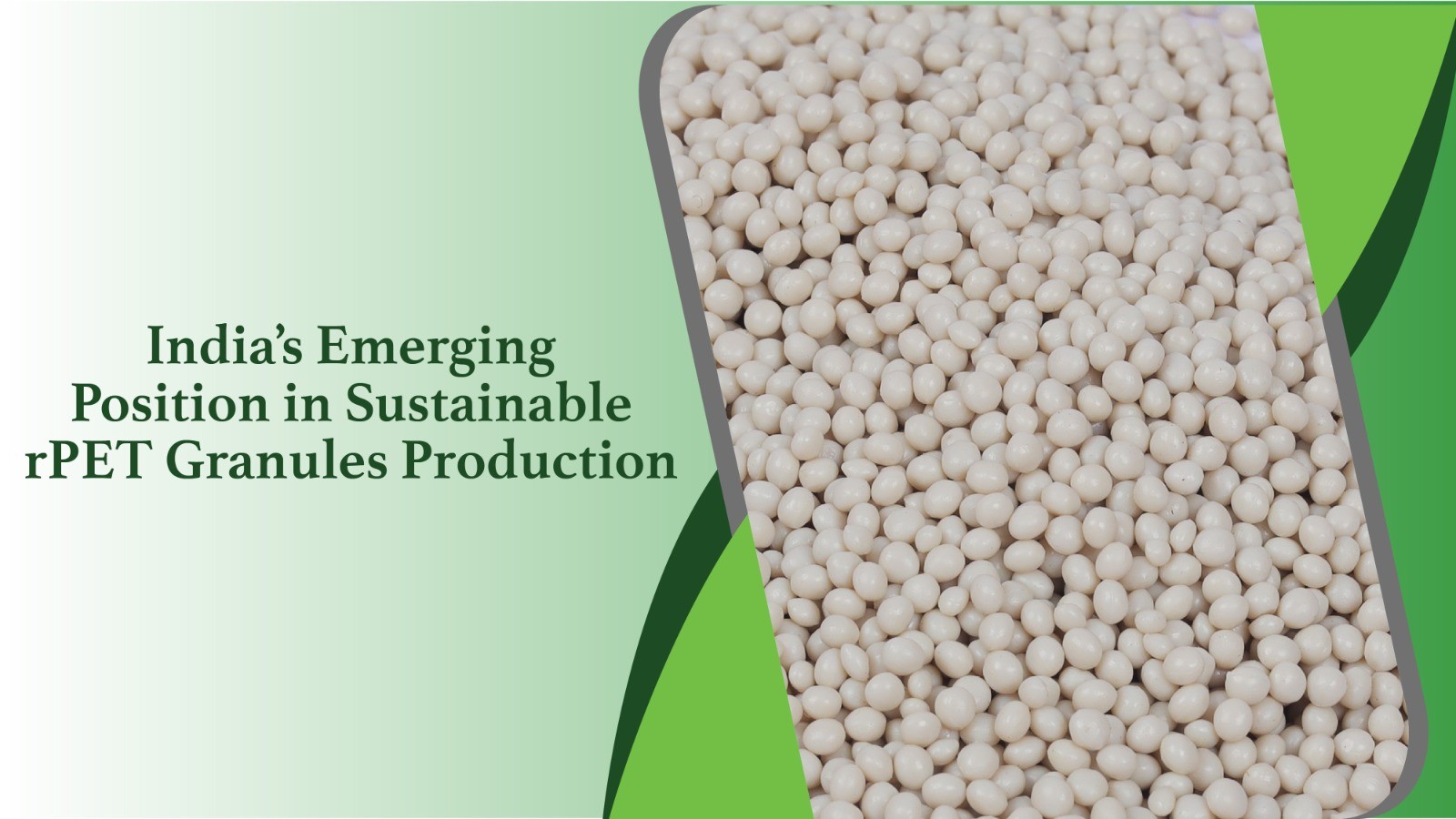
India has quickly established itself as a global recycling and circular-economy innovation leader. Among the most powerful catalysts for this growth is the new rPET Granules industry. As businesses like textiles, packaging and automotive increasingly look towards sustainable raw materials, rPET Granules have become a fundamental requirement of modern production. As the demand for high-quality recycled inputs rises, an established producer like Pashupati Group continues to set the benchmark for rPET Granules manufacturing in India.
Understanding rPET Granules
rPET Granules are polymer granules created by recycling used PET bottles and similar plastic waste. These Granules form the base material for producing fibres, sheets, strapping and containers. The recycling loop includes sorting, washing, cutting up and re-making waste PET into food-grade or textiles-grade pellets.
India currently manufactures approximately 1.3 million tonnes of PET per year and more than 70% of that is being recycled, which has one of the highest recycling rates in the world. Of these, rPET Granules have a very significant place in recycled products, linking environmental commitment to industrial utility.
The Need for Quality rPET Granules
The worldwide trend towards sustainable materials has subjected makers to immense pressure to provide homogenous, high-quality recycled polymers. Poor quality Granules result in fiber spinning, sheet extrusion, or moulding process defects.
It is a measured, multi-step process that aims to preserve polymer integrity and minimize carbon footprint in converting waste PET bottles into high-performance rPET Granules. Homogeneous viscosity, accurate colour control and low contamination levels are thus critical.
Pashupati Group, with its large-scale recycling activities and vertical integration, established a system that guarantees traceable quality right from waste collection to final pellet. With the help of high-end washing lines, optical sorters and extruders, Pashupati realizes Granules with intrinsic viscosity (IV) levels customized for textile-grade (0.64–0.70) as well as bottle-grade (0.80–0.88) uses.
The Recycling Process
It is a cautious, multi-stage process that seeks to maintain polymer integrity and reduce carbon footprint in transforming waste PET bottles into high-performance rPET Granules.
Collection and Sorting
PET bottles are collected by a pan-India network of recyclers and waste aggregators. Advanced sorting facilities utilize near-infrared sensors to sort clear PET from coloured or contaminated waste.
Washing and Flake Production
Bottles undergo label removal, hot washing and friction cleaning. The process yields pure rPET flakes with contamination below 50 ppm, ensuring compatibility with downstream polymerisation.
Extrusion and Filtration
The flakes are melted, filtered and extruded into strands that are cut into uniform Chips Granules. Pashupati’s continuous filtration systems achieve up to 5-micron purity, eliminating fine impurities that can compromise performance.
Solid-State Polymerisation (SSP)
For premium-grade end applications, SSP is conducted on Granules for recovery of molecular weight and physical strength. This processing guarantees stability in fiber spinning and injection moulding.
Quality Control and Testing
Every batch undergoes testing for intrinsic viscosity, water content and colour value (L*, a*, b*). Granules with IV variation of less than ±0.02 are cleared for shipping, in accordance with international textile and packaging standards.
rPET Granules for Textile Applications
rPET Granules textile grade form the basis for polyester staple fibers and filament yarns. These are used in huge volumes across the globe in apparel, upholstery, geotextiles and non-woven fabrics. Polyester fiber consumes almost 1.5 million tonnes of PET in India annually and the use of recycled inputs has been increasing at a rate higher than 12% year-on-year.
Pashupati Group's rPET Granules for apparel purposes have superior spinnability, uniform dye absorption and heat stability. These enable mills and spinning units to achieve efficiency in production without an increase in dependence on virgin polymers. Pashupati Group's Granules are also designed to deliver low breakage and uniform denier per filament, which are critical parameters for high-speed spinning machines.
Driving the Circular Economy
The recycling of a tonne of PET bottles into rPET Granules saves around 1.5 tonnes of CO₂ and 6,000 litres of water if produced from virgin PET. With one of India's largest integrated recycling facilities, Pashupati Group is contributing directly to India's green goals and the world's transition towards circular production habits.
The factories of Pashupati together recycle more than 3,00,000 tonnes of plastic waste per annum. Recycling value chain reprocesses material back into flakes, Granules and fiber, which are then recirculated in the industry. The system minimizes the use of fossil fuels, promotes waste segregation at source and enables local waste-collection systems.
Compliance and Global Reach
Pashupati’s rPET Granules manufacturing units adhere to internationally recognised standards, including Global Recycled Standard (GRS), ISO 9001:2015 and FDA-USA. The company’s laboratory is equipped for IV, DSC and moisture testing to ensure compliance with global textile and packaging specifications.
With an expanding chain of exports, Pashupati Group provides rPET Granules to European, Southeast Asian, as well as Middle Eastern manufacturers. Its consistency and traceability have helped India become a choice country for sourcing for brands looking for certified sustainable material.
Innovation and Future Direction
On-going investment in polymer chemistry R&D and automation improves the process efficiency and reduces energy consumption for Pashupati Group. Developments include:
- Energy-Efficient Extrusion: 25% reduction in energy usage using state-of-the-art barrel heating technology.
- Colour-Stable rPET Granules: Upgraded thermal stabilisers for clarity retention in light-coloured fibres.
- Closed-Loop Recycling: Upscaling bottle-to-bottle recycling plants to match future Extended Producer Responsibility (EPR) obligations.
These technologies not only improve product quality but also India's rPET industry becoming competitively world-class within the next decade.
The Pashupati Group Advantage
Having over three decades of experience in polymer processing and plastics recycling, Pashupati Group is engaged in various segments, like rHDPE, rPET, PP granules and polyester fibres. The vertical integration of Pashupati guarantees the attainment of complete quality, supply chain and sustainability results.
Its end-to-end recycling system, from collection to Granules manufacturing, eliminates the middlemen and minimizes logistical inefficiencies. This facilitates the predictable delivery of high-grade rPET Granules to cater to both domestic and global demand.
A Sustainable Future
The swift adoption of rPET Granules is a step in the right direction for India's approach towards recycling and industrialization. With environmental regulations clamping down, sustainability pledges by brands and consumers becoming aware, demand for reliable rPET Granules manufacturers will continue to rise only.
Pashupati Group continues to lead this revolution, marrying technology, responsibility and scale to produce materials that fuel circular momentum. The company's path is the true example of how industrial performance and environmental responsibility can exist together, building a world where recycled material is not an option but the norm.
FAQ's
RECENT BLOGS
 (Large).jpg)