BLOG
POPULAR ARTICLES

/
BLOG
Understanding rPSF: A Clear Guide to the Material, Process and Uses
10 April, 2026
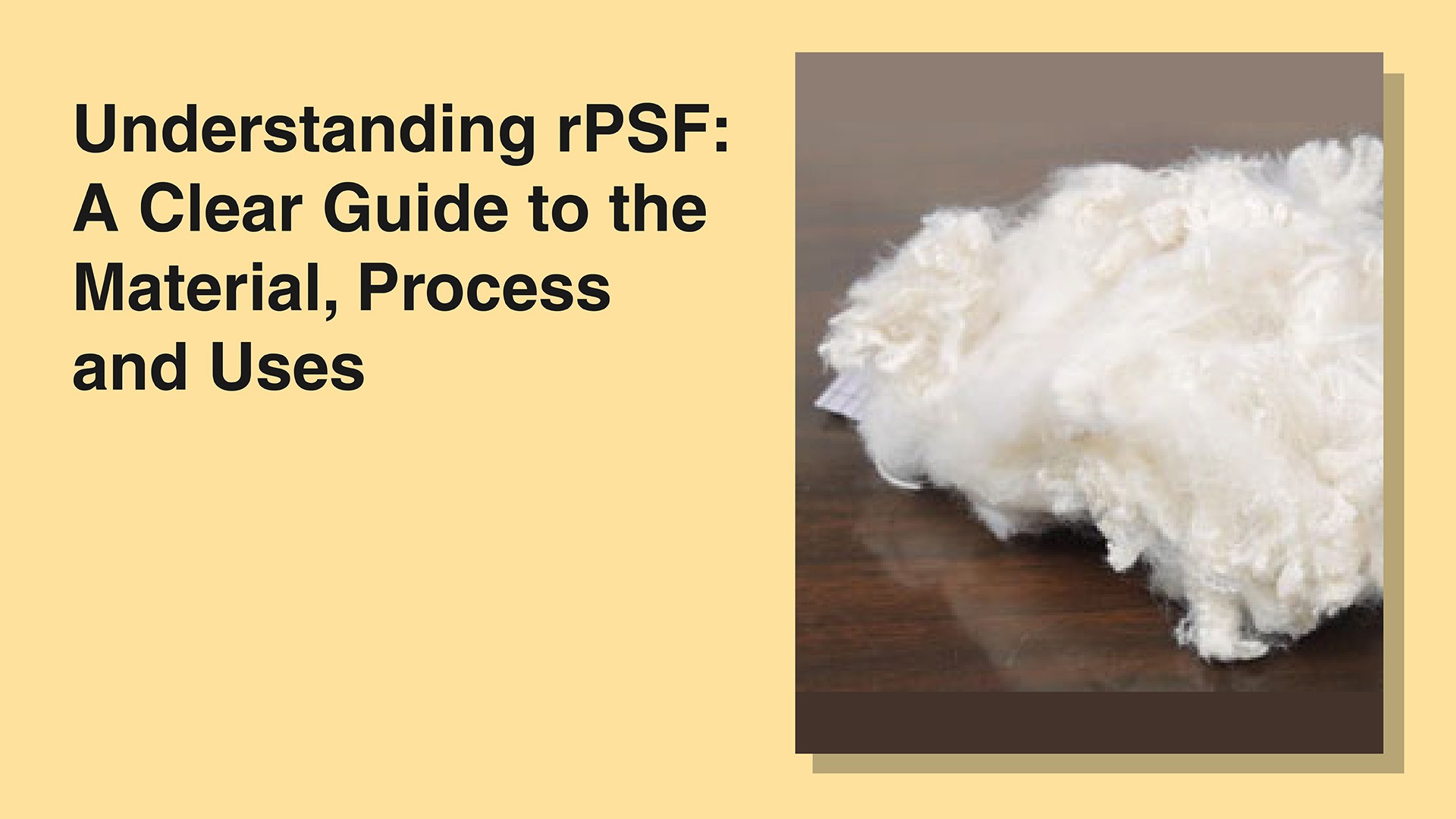
What is rPSF? Recycled Polyester Staple Fiber and Why rPSF Manufacturers Matter
Polyester has been around in manufacturing for years. It works, it processes well and it fits into a lot of different product categories without much friction. What’s shifting now is how people look at it. There’s more attention on where it comes from, how stable the quality is and whether it holds up across a longer supply chain.
That’s why recycled inputs are getting more attention, especially in sectors where both performance and scale matter. Recycled Polyester Staple Fiber tends to come up often in these discussions. It sits somewhere in between. It works within existing systems without much friction, but its origin still makes it relevant when conversations move toward material recovery and sourcing decisions.
For manufacturers, that’s the real reason to look at rPSF more closely. It’s not just about positioning. It’s a material that has to perform, run consistently and hold up in actual production conditions.
What is rPSF? Understanding Recycled Polyester Staple Fiber
Recycled Polyester Staple Fiber is thin polyester extruded from recycled PET, but instead of being left as one continuous strand, it’s cut into short lengths. That’s what changes how it behaves. These fibres can be spun into yarn, blended with other materials, or used directly in filling and nonwoven applications depending on what’s being made.
The input usually comes from post-consumer or post-industrial PET, like used bottles, packaging or factory scrap. After collection, the material goes through sorting and cleaning before it is processed into fibre. At its simplest, it’s a way of turning recovered plastic back into a usable raw material.
The material is valued partly because it does not sit in one narrow category. It can move across soft applications, functional applications and industrial uses depending on denier, cut length and finish. That flexibility is one of the main reasons rPSF stays relevant across sectors.
How rPSF Is Made by Recycled Polyester Staple Fiber Manufacturers
The journey from discarded PET to fibre is fairly straightforward in concept, but it relies heavily on control. Better input and tighter processing usually lead to more stable output.
Process Overview
- Collection of PET waste from different recovery channels
- Sorting to separate PET from other plastics, metals and visible contaminants
- Washing to remove dirt, labels, adhesives and residue
- Conversion into flakes
- Further processing into chips or fibre feedstock
- Extruding into fibres
- Cutting into staple lengths based on application needs
Each of these steps affects quality. Poor sorting can introduce contamination. Inadequate washing can affect appearance and consistency. Weak control in later stages can lead to uneven fibre properties. That is why rPSF is not just about using recycled content. It is also about how carefully the material is handled from start to finish.
In practice, this is where serious rPSF Manufacturers stand apart. A cleaner input stream usually leads to a smoother production run and a more dependable finished fibre. For buyers, that matters far more than broad claims that sound good in a brochure.
Why rPSF Is Gaining Attention Among Polyester Fiber Manufacturers
The rise of rPSF is not tied to one single trend. It is gaining ground because it answers several practical needs at once.
Resource Efficiency
Using recycled PET as feedstock helps keep existing material in use for longer instead of depending entirely on fresh input for every cycle.
Versatility Across Applications
Recycled Polyester Staple Fiber is used in a wide mix of products, which gives it commercial value beyond a niche category. Manufacturers can work with it in different forms and specifications depending on what they need the final product to do.
Alignment With Circular Practices
There is also a larger systems benefit. Recycling PET into fibre creates a visible link between waste recovery and manufacturing. Instead of ending its life after one use, the material is brought back into production. That makes rPSF part of a circular approach that is easier to explain and easier to see in action.
Ease of Adoption
Another reason it is drawing interest is that it can often fit into established polyester processing systems without requiring a complete production rethink. That matters in the real world. A material becomes more attractive when it supports change without forcing disruption.
Key Applications of Recycled Polyester Staple Fiber
One of the strongest things about Recycled Polyester Staple Fiber is how many application areas it can serve. It shows up in both everyday consumer goods and more technical product categories.
Common Use Areas
- Home textiles such as cushions, quilts and pillows
- Filling materials where softness, bulk and recovery matter
- Nonwoven products
- Textile blends for yarn production
- Industrial applications that require durability
- Select construction-related uses depending on the fibre type
This range is not just a nice feature. It is commercially useful. When one material family can support multiple end uses, procurement becomes easier to manage and production planning becomes more flexible.
It also gives manufacturers room to choose from different fibre properties based on need. One application may call for softness and loft. Another may need resilience. Another may simply need a stable input that performs consistently over volume.
What Buyers Should Evaluate Before Choosing rPSF Manufacturers
When looking at Recycled Polyester Staple Fiber in India, it’s better to move past general claims and focus on what happens in production. The real question is simple. Does it run cleanly, stay consistent from batch to batch and match the application it’s being used for?
Key Evaluation Points
- Source and quality of recycled PET
- Sorting and cleaning processes
- Fibre specifications such as denier and cut length
- Consistency across batches
- Cleanliness and contamination control
- Compatibility with the intended application
- Supply capacity and continuity
These are the points that shape performance in a factory, not just in a presentation deck. Buyers often benefit from trial runs because fibre behaviour can look different under actual operating conditions. That extra step makes sense, especially when the output product depends heavily on texture, fill quality or process stability.
rPSF Manufacturers and Polyester Fiber Manufacturers in India
India plays an important role in the wider recycling and fibre ecosystem because it has both manufacturing depth and a growing recovery network for plastic waste. That creates a strong base for recycled material processing and downstream use.
The presence of multiple Recycled Polyester Staple Fiber Manufacturers in India reflects that growth. It also means buyers need to look closely at who does what well. Some suppliers are geared toward scale. Others may be stronger on consistency, grade control or application-specific supply. The category is broad enough that not every player serves the market in the same way.
Many Polyester Fiber Manufacturers are also expanding into recycled material production as demand grows across industries.
Within this broader landscape, Pashupati Group is relevant as part of India’s larger recycling and fibre ecosystem. That matters from an industry perspective because the conversation around rPSF is no longer isolated. It now sits within a larger chain that includes collection, sorting, recovery, processing and downstream material use.
Challenges Faced by rPSF Manufacturers
Like any recycled material, rPSF depends heavily on input quality and process discipline. When those two things are strong, the material can perform well. When they slip, problems show up quickly.
Common Challenges
- Variation in feedstock quality
- Contamination risks during collection and sorting
- Colour consistency across batches
- Moisture control during processing
- Maintaining uniform fibre properties
These are not minor issues. They affect production efficiency, output quality and application suitability. That is why the best rPSF Manufacturers usually invest in cleaning systems, sorting discipline and steady process control instead of relying on recycled content as a headline alone.
The Role Of rPSF In Modern Manufacturing
rPSF reflects a broader change in the way materials are viewed. Waste is no longer seen only as an endpoint. In the right system, it becomes input again. That changes the logic of sourcing and opens up a more continuous material cycle.
For manufacturers, this creates practical opportunities. It allows them to work with a familiar fibre category while participating in more structured recycling systems. For buyers, this adds another layer to the decision. It’s not only about performance, but also about where the material fits within their overall sourcing approach.
Where Recycled Polyester Staple Fiber Fits Today
Recycled Polyester Staple Fiber continues to gain relevance because it speaks to both function and material origin. It works in established manufacturing environments, supports a wide range of applications and fits neatly into the growing interest around material recovery and smarter resource use.
That is what makes rPSF worth paying attention to. It is not just a recycled substitute. It is a practical material category in its own right and one that is becoming harder to ignore as supply chains evolve.
FAQ
What is rPSF used for?
Recycled Polyester Staple Fiber is used across textiles, filling products, nonwovens, cushions, quilts, pillows, automotive interiors, and various industrial applications depending on the fibre specification.
What does staple fibre mean?
Staple fibre means fibre that is cut into fixed lengths instead of remaining as one continuous strand. This makes Recycled Polyester Staple Fiber easier to spin, blend, and use in filling applications.
What raw materials are used to make rPSF?
Recycled Polyester Staple Fiber is usually made from recycled PET sourced from post-consumer or post-industrial waste streams such as plastic bottles, packaging waste, and factory scrap.
Why is rPSF considered useful in manufacturing?
Recycled Polyester Staple Fiber offers versatility, supports better resource efficiency, and can be adapted across multiple product categories while remaining compatible with existing polyester-based systems.
How should buyers choose rPSF suppliers?
Buyers should evaluate feedstock quality, sorting and cleaning standards, fibre consistency, technical suitability for the application, and the supplier’s ability to maintain stable production and delivery.
Is Recycled Polyester Staple Fiber eco-friendly?
Yes, Recycled Polyester Staple Fiber helps reduce plastic waste by converting used PET materials into reusable fibre, supporting recycling systems and better material recovery practices.
Can Recycled Polyester Staple Fiber be used in home textiles?
Yes, Recycled Polyester Staple Fiber is widely used in home textiles such as cushions, mattresses, quilts, pillows, and upholstery where softness, resilience, and durability are important.
What is the difference between virgin polyester and Recycled Polyester Staple Fiber?
Virgin polyester is made from new raw petrochemical materials, while Recycled Polyester Staple Fiber is produced using recovered PET waste such as bottles and packaging materials.
Is Recycled Polyester Staple Fiber suitable for nonwoven applications?
Yes, Recycled Polyester Staple Fiber is commonly used in nonwoven products because it offers flexibility, bulk, and stable performance across different manufacturing processes.
Why do Polyester Fiber Manufacturers use Recycled Polyester Staple Fiber?
Polyester Fiber Manufacturers use Recycled Polyester Staple Fiber because it supports efficient production, works across multiple applications, and helps meet growing demand for recycled material solutions.
Does Recycled Polyester Staple Fiber maintain consistent quality?
Quality depends on the source material and processing standards. Reliable rPSF Manufacturers focus on sorting, cleaning, and production control to maintain consistency across batches.
Which industries commonly use Recycled Polyester Staple Fiber?
Industries such as textiles, automotive, furniture, construction, home furnishing, packaging, and industrial manufacturing commonly use Recycled Polyester Staple Fiber for different end-use applications.
How do rPSF Manufacturers ensure fibre quality?
rPSF Manufacturers maintain quality through proper PET sorting, advanced washing systems, contamination control, moisture management, and strict monitoring of fibre denier and cut length.
Is Recycled Polyester Staple Fiber cost-effective for manufacturers?
Yes, Recycled Polyester Staple Fiber can be cost-effective because it supports material recovery, works within existing systems, and offers flexibility across multiple product categories.
Can Recycled Polyester Staple Fiber be blended with other fibres?
Yes, Recycled Polyester Staple Fiber can be blended with cotton, viscose, and other synthetic fibres to improve product performance, texture, and functionality depending on the final application.
FAQ's
RECENT BLOGS
 (Large).jpg)